What Documents Do You Need to Deregister and Scrap a Car in Singapore?
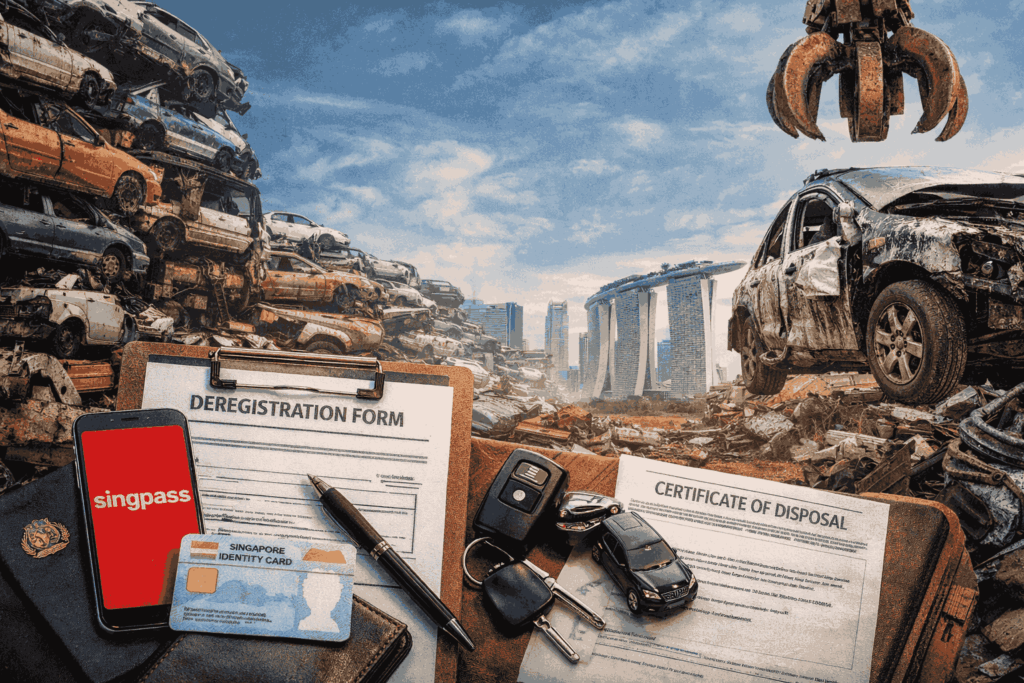
If you are planning to deregister and scrap your car in Singapore, the good news is that the paperwork is usually straightforward when you work with the right scrap car dealer. In most cases, the key items are your identification, access to the deregistration process through OneMotoring, and the disposal or export documents that must be submitted after the vehicle is deregistered. Singapore’s official guidance states that owners can deregister online through OneMotoring, and disposal documents must be submitted after the car is scrapped or exported.
Many car owners worry that they need a huge stack of forms before starting. In reality, the exact documents depend on who is submitting the deregistration, whether the owner is eligible to use Singpass, and whether the car is being scrapped locally or exported. For applicants who are not eligible for Singpass and need to transact at LTA’s Customer Service Centre, LTA provides a specific deregistration form.
The short answer
For most private car owners in Singapore, the documents and items you should prepare to deregister your car in Singapore are:
- your NRIC or valid identification
- access to Singpass for OneMotoring online submission
- your car’s basic details, such as registration number
- the disposal proof from the scrapyard or exporter after the car is collected and processed
- any supporting authorization documents if someone is acting on your behalf
LTA’s identification requirements state that a physical NRIC, long-term pass card, or the Digital IC in the Singpass app may be required for in-person verification, and images or videos of identity documents are not accepted for that purpose.
1. Identification documents
The first thing you need is proper identification.
If you are the registered owner, prepare:
- NRIC if you are a Singapore citizen or PR
- relevant pass documents if you are a foreigner
- Digital IC via Singpass app where accepted for verification
If deregistration is being handled physically at LTA in a special case, LTA’s identification guidance makes clear that proper original identification is required, and not just a screenshot or photo of your ID.
If someone else is acting for you, extra authorization documents may be needed. LTA’s identification guidance also refers to cases involving third parties and power-of-attorney style arrangements, depending on the owner type and circumstances.
2. Singpass access for online deregistration
Most owners should expect to deregister their vehicle through OneMotoring’s digital services, which generally requires login access. That means your “document” is not just paper paperwork — it also includes your ability to log in with Singpass and complete the transaction online. OneMotoring’s digital services page confirms that many transactions are done online and may require login.
This is why, before your scrap appointment, you should make sure:
- your Singpass is working
- your mobile number is active for authentication
- the vehicle is registered under the correct owner details
3. Deregistration application form, only in some cases
Most owners using Singpass will not need to fill in a manual paper form. However, if you are not eligible for Singpass and need to go through LTA Customer Service Centre, LTA provides Form D01: Application for Deregistration of a Vehicle and Grant of PARF / COE Rebate(s). The form itself states that it is for applicants who are not eligible for Singpass and need to carry out the transaction at the LTA Customer Service Centre.
So this form is not for everyone. It is only needed in specific situations.
4. Disposal documents after the car is scrapped or exported
This is one of the most important parts.
After your car is deregistered, you must submit the proper disposal documents to LTA. OneMotoring states that disposal documents corresponding to the mode of export must be submitted, and owners are required to enter export details when uploading them. The official page also notes that vehicle registration documents from another country may be accepted in some export situations.
If your car is being scrapped locally, the scrapyard or your appointed dealer will usually help arrange the disposal proof.
If your car is being exported, the required documents may differ depending on whether the vehicle leaves by ocean freight, land, or is registered overseas afterward. OneMotoring provides sample disposal document references for these cases.
This is why it is helpful to work with a direct scrap/export dealer who already handles these submissions regularly.
5. Authorization documents if someone is handling it for you
If the owner is not the person physically submitting the request or supporting paperwork, supporting authorization may be required. LTA’s identification document guidance refers to cases where third parties act on behalf of the owner and where original identification of the third party must also be produced.
In practical terms, this may apply if:
- a family member is helping you
- a company representative is acting for a business-owned vehicle
- an agent is assisting with the process
- the owner is overseas
In these cases, it is smart to confirm the exact supporting documents before making the trip or submission.
6. Documents for company-owned vehicles
If the vehicle is owned by a company instead of an individual, the paperwork can be different because LTA may require proof that the person acting has authority to do so. The identification guidance published by OneMotoring distinguishes between owner types such as individual, company, and business.
For company cars, prepare:
- company authorization documents
- the representative’s identification
- any forms or supporting documents requested for the specific transaction
7. Do you need the log card?
Many owners still ask about the old “log card.” Today, most owners focus on digital access and vehicle records via OneMotoring rather than relying on older physical paperwork. Since deregistration is mainly handled through OneMotoring digital services, what matters most is that your owner details and login access are correct.
8. What happens after deregistration?
Once the vehicle is deregistered, you cannot use it on the road. You must then make sure the vehicle is properly scrapped or exported and that the required disposal documents are submitted. Singapore’s official deregistration page also ties the process to rebate handling and disposal proof.
Your eventual scrap car value may include PARF and COE-related components, depending on the vehicle and eligibility, which is why owners should check their numbers before deciding whether to renew, sell, export, or scrap. Your existing site already explains that scrap value can include PARF and COE components, which makes this a good internal link opportunity from this article.
Common mistakes to avoid
One of the biggest mistakes is assuming that the process ends right after deregistration. It does not. Disposal or export proof still needs to be submitted afterward. Your existing deregistration guide on scrapcars.sg also warns that disposal proof must be submitted after deregistration.
Other common mistakes include:
- waiting until the last minute to check Singpass access
- using the wrong owner details
- not preparing identification for verification
- not confirming whether the dealer will handle the disposal documents
- not understanding whether the vehicle should be scrapped or exported for better value
Simple checklist before you start
Before deregistering and scrapping your car in Singapore, prepare this:
- NRIC or valid identification
- Singpass access
- vehicle registration number
- confirmation of who is handling the transaction
- authorization documents if a third party is involved
- disposal/export documents after the vehicle is processed
- rebate and scrap value check before you commit
Final thoughts
If you are a normal private owner, the process is usually much easier than it sounds. In many cases, you mainly need your identification, Singpass access, and a reliable scrap/export partner who will help ensure the disposal paperwork is properly handled after deregistration. The official Singapore process is digital-first, and the supporting documents depend on whether the vehicle is scrapped locally, exported, or submitted through a special case at LTA.